A Culture of Learning: Hadassah Scientists Lead US Course on Organoids
“Organoids are transforming how we study human biology. Traditionally, we were relying heavily on animal models to study human disease. Organoids allow us to experiment our ideas directly on real human cells.” — Myriam Grunewald, PhD, Hadassah Organoid Center
Maximum Learning With Miniature Organs
Move over sea robins, horseshoe crabs, skates and squid, there’s a new specimen in town.
The venerable Marine Biological Laboratory (MBL) on Cape Cod, Massachusetts, known for collecting marine life from the local bay for research year-round, was also home this summer to organoids generated in a lab in Israel. Frozen, packed up and shipped out in dry ice, the organoids were a central feature of an intensive course spearheaded by Myriam Grunewald, PhD, head and scientific director of the Hadassah Medical Organization’s (HMO) Organoid Center, who came to the US with her team to teach 11 students from all over the world.
An organoid is a “mini organ in a dish, or a patient in a dish,” said Grunewald. It is a three-dimensional structure grown from stem cells that reproduce key cellular and functional features of the tissue from which it originates. When generated from a patient’s cells, organoids can preserve important individual characteristics, which make them valuable for studying disease, testing treatments and developing more personalized care.
The course, Organoid Biology: From Concept to Practice, spanned four weeks and was designed to impart HMO’s knowledge of and expertise in the cutting-edge world of organoids.
“Organoids are transforming how we study human biology,” Grunewald said. “Traditionally, we were heavily relying on animal models to study human disease. Organoids allow us to experiment our ideas directly on real human cells.”
Working 9 to 9
The rigorous course combined classroom learning with real hands-on training, reaching far beyond the fundamentals of how an organoid is made to cover its diverse applications in personalized medicine, drug testing, disease modeling, AI and regenerative treatment. It took about eight months to develop the syllabus.
“We have students that had a previous course on organoids somewhere else in Europe or in the US, but I think what is special about this course is its breadth,” said Grunewald. “We wanted participants not only to learn how to grow organoids, but also to understand how the technology can be applied to very different scientific and clinical questions.”
The student body comprised PhD candidates, post-doc fellows, assistant professors and biotech company technicians from several countries. Each participant underwent a competitive application process designed to select students who would benefit from learning the technology, take it back home and use it in their own research. Class instructors and lecturers included Grunewald’s HMO colleagues and special guest speakers, all notable in their fields. A team from Cincinnati Children’s Hospital also joined the course to provide hands-on training in generating organoids from pluripotent stem cells, complementing Hadassah’s expertise in adult stem cell-derived organoids.
The 30 samples brought from Israel were intestinal cystic fibrosis organoids, as well as lung cancer, breast cancer and colorectal cancer organoids, all derived from HMO patients. Each type of organoid has its own way of being cultured, making it important for the students to learn the differences, according to Grunewald. Taking advantage of MBL’s unique environment, the class also used aquatic species, generating organoids from a zebrafish, a sea cucumber and a frog.
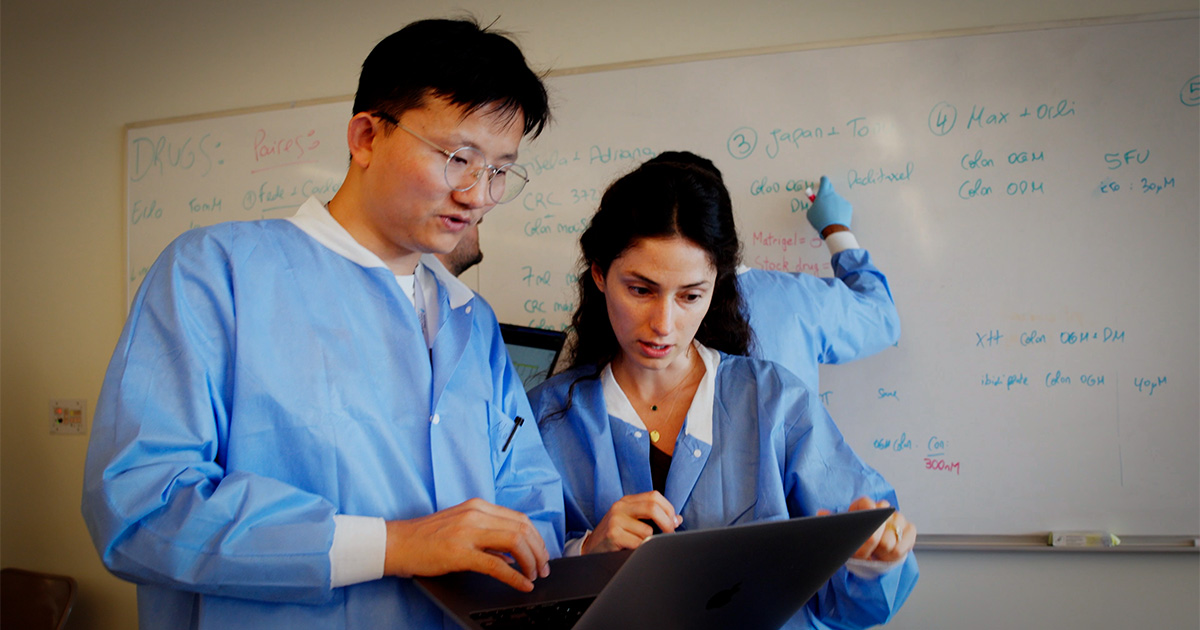
Each day saw the students transition between lecture and lab, working round the clock from 9 am to 9 pm, with breaks only for lunch and dinner. Their blue lab coats and rubber gloves became the unofficial class uniform.
The introductory module, led by PhD student Deborah Duran, covered the basics; the class created a mouse organoid and learned how to handle, process, plate, maintain, freeze and expand it (grow more organoids from one), among other techniques.
“Seeing the look in their eyes when they realized, ‘Wow, it grows!’” was especially exciting for Grunewald.
Four more modules followed, with three led by Organoid Center staff: patient-derived intestinal organoids in cystic fibrosis (Dr. Liron Birimberg-Schwartz, a pediatric gastroenterologist and the Organoid Center’s medical director, and Shira Fine-Leebhoff), drug response on colon cancer-derived organoids (Duran, PhD student Orli Halstuk and Omri Schatz), and ethics and regulatory considerations (clinical coordinator Nadav Kaplan Komornik). A final module on AI and data integration was taught by Dr. Tomer Batash, HMO’s director of innovation in ophthalmology.
Guest speakers included Dutch organoid technology pioneer Dr. Hans Clevers, via Zoom, and Jim Wells, PhD, and his team from the Wells Lab at Cincinnati Children's, Dr. Juan Gnecco from Tufts University, Dr. Avi Rosenberg from John Hopkins and Dr. Moshe Biton from the Weizman Institute.
Being at MBL also gave the class access to Nobel Prize winners, including Israeli Dr. Avram Hershko, who spoke about winning for his work in biochemistry.
“I really want to expose them to the versatility of this model and show them how they can use it to address very different questions in their own research. So I think this is what makes this course unique. Rather than focusing on just one aspect of organoid technology, we expose the students to a broad range of models, approaches and applications,” Grunewald said.
“It’s something that I wanted to do a lot at the University of Chicago, but it’s been a little bit of a hurdle because it’s just such a new technology, and it’s so hard to find the people willing to teach you in such a profound way,” said Tonu Pius, a PhD candidate in microbiology. Pius took the course to learn how to grow and culture his own organoids and teach his lab back home how to do the same.
For Meghna Gupta, PhD, assistant professor at Oregon Health and Science University, the course “has been an amazing opportunity for people like me who actually want to work on more disease-relevant models.” A biochemist and structural biologist, Gupta has been working with 2D culture aspects, “but when we talk about tissues, 3D organoids are more relevant in terms of recapitulating the actual tissue function,” she added.
Women in Their Element
Gupta was one of the five women in the class, alongside six men. Grunewald was intentional about having gender balance among participants. “Scientific talent is distributed equally, but opportunities have not always been. It was important to me that talented women were well represented in the course and had the same opportunity,” she said.
“Women have played an essential role in advancing science throughout history, and I believe it is important to create the opportunities that allow them to fully contribute and lead,” she said.
Grunewald’s passion for science started early. As a child in southern France, she wanted to understand how living things function, what keeps them alive and what happens when those processes fail. Her role model — her older sister, a dentist who also holds a degree in chemistry — challenged her curiosity, often asking her, “How do you think this works?”
Later, her mentors at the Hebrew University of Jerusalem helped advance her career. Prof. Baruch Kanner “raised me as a scientist” and taught her rigor, and Prof. Eli Keshet taught her to remain open to unexpected findings and new ideas.
Hadassah, she said, “has given me the freedom to broaden my perspective in science and to explore things in translational medicine I might never otherwise have been able to do.” She has been with the Hadassah Organoid Center for over five years.
Several Countries. One Classroom.
The class reflected diversity in more than gender alone, bringing together students from across the globe, including India, Argentina, Austria, Japan, Puerto Rico, Peru, Portugal and the US.
Like Hadassah hospitals in Israel, this course served as a model for coexistence. Said Grunewald, “When you are a biologist and you work in a lab, you are not identified by your nationality, religion or your political ideas. We all have the same curiosity and the same passion for science, and our goal is to make the world better. I think this type of relationship builds trust between us, and trust is the base for peace.”
“If we are going to tackle the challenges of the future, if we are to develop therapies that are important for patients in need, global collaboration is going to be a pioneering need for developing such therapies,” said student Japan Mehta, a PhD candidate from India studying immunology at Virginia Commonwealth University in Richmond, Virginia.
Even upon arriving in Massachusetts, Grunewald spoke of her warm welcome. “I couldn't feel better. It was a super positive experience.”
Staying on Course
“Partnering with the Hadassah Organoid Center to bring this course to the MBL for the first time has been a wonderful experience,” said the Marine Biological Laboratory’s Linda Hyman, PhD, the former Burroughs Wellcome director of education. “Myriam Grunewald and her team brought deep technical expertise in organoid biology, and it showed. Launching this collaboration in the course’s first year has set an incredibly high bar, and we couldn’t have asked for a better inaugural partner in advancing this science.”
According to Grunewald, the course was successful in achieving its intended purpose. Two students, both assistant professors, plan to use images generated during the course for their program applications. Two others have expressed interest in coming back next year as technician assistants to further their learning.
Grunewald and her team are already planning ahead for next summer. “Next year, maybe we will do a more advanced course where we’ll be able to increase the complexity of the organoids” when it comes to cancer and vascularized organoids. She also aims for next year’s AI module to be less theoretical and more hands-on.
The Center of It All
The Hadassah Organoid Center at Hadassah Hospital Ein Kerem, the first of its kind in Israel, was established in 2020. Its organoid biobank was introduced a year later, and it currently carries samples from more than 500 patients. The organoids are stored and made available to researchers in Israel and around the world.
Hadassah uses organoids to model diseases, test drugs and advance personalized medicine. It applies organoids to areas including cancer, cystic fibrosis, inflammatory bowel disease, rare skin diseases and endometriosis, with the goal of helping doctors predict which treatments will work best for each patient. For cancer, organoids are being used to test how a patient’s tumor may respond to a specific cancer treatment. The approach still needs clinical validation before doctors can prescribe medication based on the organoid results.
“What makes the Hadassah Organoid Center distinctive is its position at the interface between the hospital and the research laboratory,” said Grunewald. “We have direct access to patients and clinical expertise, while at the same time maintaining a large organoid biobank, providing research services and developing our own basic and translational research programs. This combination allows us to move continuously between biological questions, patient-derived models and potential clinical applications.
“Organoids are widely used in academic research, but their clinical applications are still developing. At Hadassah, our location within the hospital allows us to connect this technology directly to patients and clinical needs. I believe this is an area where Hadassah can play a pioneering role” added Grunewald.
For helping make her work possible, Grunewald sends a message of gratitude to Hadassah’s 300,000 members and supporters. Feeling supported and heard, she said, “It's not every day that someone asks you, ‘What can I do to help you? What you are doing is important.' They are the wind in our sails."