
.svg)


Normalization. Trust. Oath.
These three words stood out during the first-ever live joint podcast episode presented by Hadassah Magazine Presents and Hadassah On Call focused on the rise of antisemitism in healthcare after October 7, 2023.
Watch the podcast and see, further down in this story, what you can do to fight antisemitism with Hadassah.
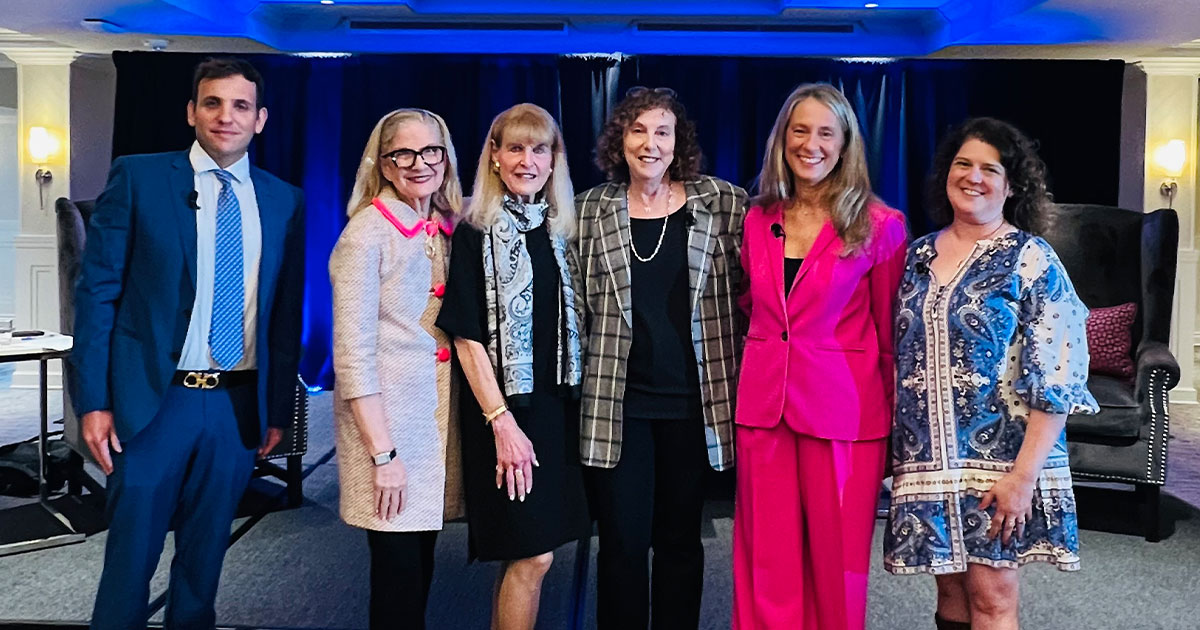
Hosted by Hadassah Greater Detroit at the Kingsley Hotel in Bloomfield Hills, Michigan, and moderated by Hadassah Magazine Executive Editor Lisa Hostein, the June 9 conversation featured Dr. Michelle Elisburg, pediatrician and co-chair of the Hadassah Physicians Council; Dr. Uri Hadelsberg, spine surgeon at the Hadassah Medical Organization, and Michelle Stravitz, CEO emeritus of the American Jewish Medical Association (AJMA), discussing the considerable impact of antisemitism on medical professionals, patients and medical students.
They highlighted the:
- Normalization of antisemitism and acceptance of expressions of hate in all fields of healthcare.
- Lack of trust that patients will be well taken care of, regardless of their beliefs.
- Oaths that are being violated when providers pick and choose who’s a worthy patient.
“Who would think that in a space like healthcare, this would emerge?” Stravitz said to an audience of 80.
But just weeks after October 7, she noted, doctors were seeing antisemitism “in every relationship that you can imagine in healthcare … physician to physician, or provider to provider, nurse to nurse, mental health professional to mental health professional, providers doxing their colleagues.”
This shift in the healthcare space has made it increasingly acceptable to not only outwardly express hate, but also to refuse to work with a certain colleague — or even treat a certain patient. And that is why, Stravitz said, AJMA came about: a group of doctors filling a need for support and to address these issues. “Antisemitism in medicine puts us all at risk.”
“You're supposed to do what's in the best interest of your patient and take care of the patient,” said Dr. Elisburg, who advocates on behalf of the Hadassah Physicians Council. “And so I find it very troubling that people feel there are certain kinds of patients they won't take care of.”
Dr. Elisburg continued, “Even medical students are learning that they can pick and choose which kind of patients are worthy of being taken care of, and it's just something I just don't even understand…. This just violates any kind of oath that we take.”
What’s more, Jewish medical students are being ostracized by peers and discriminated against by faculty. There has also been a drop in the number of Jewish students in certain classes. Since Jews were not seen as a minority, panelists said, medical students weren’t taught in DEI education what can be offensive or threatening to their Jewish peers.
Ultimately, the American Academy of Pediatrics (AAP) and AJMA, according to Dr. Elisburg, successfully achieved adoption of a resolution to include Jews as minorities in DEI spaces.
Dr. Elisburg and Dr. Hadelsberg shared how they personally have been on the receiving end of hurtful comments on the job.
“I wear a Magen David at work… I feel I’m pretty obviously Jewish,” said Dr. Elisburg, who works in Louisville, a large refugee settlement area, treating Muslims, Christians, Hindus and more. “I feel that after October 7, things really changed and changed in the workplace. A lot of it is maybe not intentional or meant to be hateful, but the things that I experienced show how ignorant people are about the Jewish faith.”
Down in Florida, Dr. Hadelsberg’s fellowship at the University of Miami's Miller School of Medicine brought him face to face with a scrub tech who said to him, “Allah will finish his job with your people.” It “kind of struck me there,” Dr. Hadelsberg said. In the neurosurgical intensive care unit at Hadassah Hospital Ein Kerem, however, where some 50 percent of the nurses are Arab or Muslim, it’s a positive work environment, he said. “We’re friends, right?”
Potential solutions include enforcing institutional regulations and standards. “The medical community is very regulated. There's a lot of rules,” said Stravitz, so “it's looking at the rules that you're supposed to be following in the first place, never mind the obvious ethics that people should be held accountable for.”
According to Dr. Elisburg, patients can also be part of the solution. “I think what has to happen is you have to feel empowered to make claims and call people and report it and let it be known, because part of the thing is, if we're silent about it and you just take it in, nobody really knows it's a problem.”
Hadassah Advocacy
Hadassah has been leading efforts to raise awareness and push back against antisemitism in healthcare through meeting with members of Congress, engaging with healthcare leaders and urging further action to hold individuals and professional associations accountable for acts of bias and discrimination. Through her activism with Hadassah, Dr. Elisburg met in January with the Office for Civil Rights at the Department of Health and Human Services to urge officials to treat antisemitism as a civil rights violation. “It’s a violation of our civil rights as Jews being discriminated against based on your national origin, your ethnicity, your religion; any of these things are really violations of the law,” said Dr. Elisberg. Hadassah, AJMA and other partners spoke with officials about the importance of changing the narrative. “I think they heard us," she said. "It was a very good conversation.”
Additionally, in May, Hadassah leaders met with seven members of Congress, including Rep. Bobby Scott (D-VA), Rep. Greg Murphy (R-NC), Rep. Gus Bilirakis (R-FL), Rep. Mariannette Miller-Meeks (R-IA), Rep. Marc Veasey (D-TX), Rep. Joe Wilson (R-SC) and Rep. Neal Dunn (R-FL), to engage their support in fighting antisemitism in healthcare.
These meetings took place in advance of a hearing, Bad Medicine: Politics, Unions, and Antisemitism in Health Care, called by the House Education and Workforce Committee’s Health, Education, Labor and Pensions Subcommittee. Hadassah submitted testimony for the record, highlighting the concerns of the Jewish community and urging accountability for individuals and professional associations complicit in acts of bias and discrimination.
The Detroit event featured opening remarks by Ellen Hershkin, Hadassah Magazine chair and past Hadassah national president, and closed with Hadassah National President Carol Ann Schwartz. It was supported by the DeRoy Testamentary Foundation.
Following the program, Dr. Elisburg said that approaching antisemitism as civil rights violations may have resonated most with the audience, offering something new to consider.
“My biggest takeaways are how much both physicians and patients don't know about how antisemitism presents in the medical world and how it can affect their patient care,” she said.
What You Can Do
Be part of Hadassah’s lifechanging work. Together, we fight hate and antisemitism in the US.
Make your voice heard and learn more:
- Act Now: Tell Congress to address the pressing issue of antisemitism in healthcare.
- Read Hadassah’s testimony to Congress.
- Read more about Hadassah leaders meeting with Administration leaders and members of Congress.
Be sure to tune in to Hadassah’s podcasts — Hadassah Magazine Presents and Hadassah On Call — anytime, anywhere.