
.svg)


It could have ended differently:
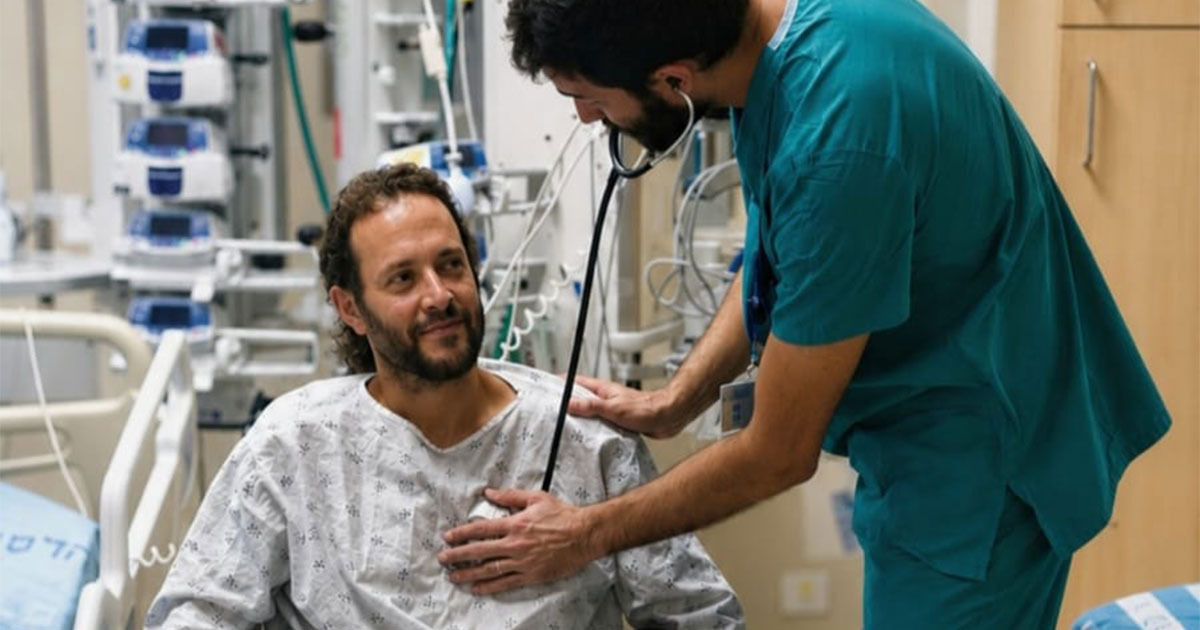
Moshe Koblenz, 38, works in logistics and event production in the Judean Desert. He is married to Hadar and is the father of 8 1/2-month-old Kerem.
On Saturday evening, he arrived at his home in Tekoa after a long trek in the desert. When he got out of the car, he was alone. It was dark, and he was wearing open-toed sandals.
When he stepped on the snake and was bitten, he said that panic made him fling his sandals forward. For the first few minutes, he didn't feel anything, but just in case, he quickly went to a neighbor’s house and knocked on the door, where he collapsed. He said he felt the poison start to spread through his veins: "I literally collapsed as soon as I managed to call for help." The neighbor immediately called a community nurse, who saw the bite and called an ambulance, which quickly took him to Hadassah Hospital Ein Kerem.
Koblenz said that he was conscious the entire time and suffered from excruciating pain. "I felt the poison overwhelm me. I was short of breath, had heart palpitations in the ambulance, and didn't know what would happen to me."
At first, he thought that even if it was a snake bite, he would receive antivenom and be fine. However, he did not know that he was bitten by an Israeli mole viper, for which there is no antivenom in Israel — or anywhere in the world.
Dr. Roy Kofman, an internal medicine specialist and cardiology resident at Hadassah Ein Kerem who treated Koblenz, said, "In the initial tests and evaluation we carried out, I noticed that cardiac injury was the main component of his severe condition, which immediately led to the suspicion that he had been bitten by the Israeli mole viper.
“This is the only snake in Israel whose bite is primarily characterized by cardiac complications. The geographic location where he was bitten matches the habitat of this snake, whose venom is the deadliest of all Israel's venomous snakes. Furthermore, Moshe’s heart activity was very weak and showed a severe decrease in contractions. Given the clinical picture, we decided to admit him to the cardiology intensive care unit."
Meanwhile, Koblenz’s condition continued to deteriorate, and the team prepared for the possibility of connecting him to a cardiopulmonary device (ECMO) should his bodily systems collapse.
Dr. Kofman continued, “At Hadassah hospitals, we have antivenom for venomous snake bites, and of course, we use it, especially in the summer months. It is critical in saving lives, but it does not cover the poison of the Israeli mole viper. Therefore, we began intensive treatment with high-dose oxygen and medications that strengthen the heart's contraction and even dilate the blood vessels that have contracted due to the venom.”
"This is a severe physical condition and a real danger to life," emphasized Dr. Kofman. "The next six hours were critical. We were prepared for any deterioration and maintained continuous monitoring of his vital signs, but the immediate treatment and the unit's staff's great efforts paid off. Within a few hours, his condition began to improve, and now he is out of danger."
Dr. Kobi Assaf, an expert in emergency medicine at the Hadassah Medical Organization who specializes in treating venomous animal injuries, emphasized that such snake bites are rare and are not encountered often in emergency rooms.
"Moshe was fortunate to receive treatment from the cardiac unit team,” Dr. Assaf said. “It was exactly the right care, and they delivered it excellently.”
“If a person feels a bite and does not know which animal caused it, various tests can help determine the source,” Dr. Assaf explained. “We ruled out that it was from an adder (snake), but at the same time, Sarafotoxin in the snake's venom is the known cause of heart damage."
Hadar, Koblenz's wife, recalled, "At that moment, we didn't yet know that it was a real life-threatening situation. It was only when I arrived that I began to understand the seriousness of the situation.
"In such situations, it is very important to act as quickly as possible, even when there is doubt about the bite,” Koblenz stressed.
That’s what saved his life.
“As of today, Moshe's heart is recovering and functioning normally. He is still being treated in the cardiac intensive care unit, but he is getting stronger," Dr. Kofman reported. "There is no doubt that in such exceptional and difficult cases, where the mortality rate is high, the immediate arrival at the cardiology department at Hadassah Ein Kerem and the intensive treatment saved his life."