
.svg)


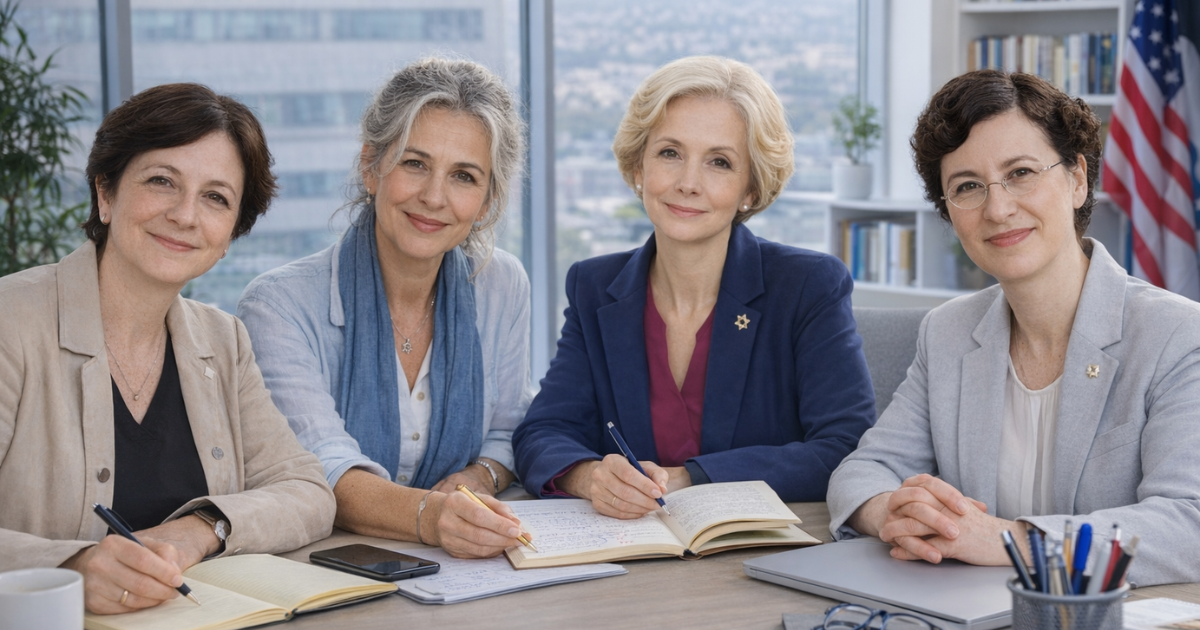
Explore how Henrietta Szold, Alice Seligsberg, Jessie Sampter and Nellie Straus Mochenson built the foundation of Hadassah’s global impact.
Henrietta Szold established healthcare in Israel, built our organization and changed countless lives — but she didn’t do it alone. She was surrounded by Hadassah women. This Women’s History Month we’re reflecting on four Hadassah women whose impact can be felt today in Israel, the United States and around the world — and we are imagining what their leadership might look like today.
Alice Seligsberg, Jessie Sampter, Nellie Straus Mochenson and Henrietta Szold came of age in the early 1900s, at the dawn of rapid urban development and industrialization in New York City. The subway had just opened, and millions of immigrants from Europe were moving through Ellis Island and filtering into the US, starting businesses, sharing their cultures and shaping the country. Amid the convergence of perspectives on society, economics and governance — and despite the fact that Israel was not yet a state, and women were not permitted to vote, own property or control their own assets — Hadassah women established a place for Zionist, feminist thinking.
Over the course of decades, they worked to make space for Jewish women in society and to turn their compassion into action. Concerned about poverty, illiteracy, poor health and insecurity both in the US and in then-Palestine, their thought leadership went beyond theoretical into the practical: they taught, organized, implemented and built the foundations of Hadassah’s lifechanging work today.
Alice Seligsberg: The Humanitarian
After Seligsberg graduated from Barnard College in 1902, she went to work on child and family wellbeing in the Lower East Side of New York City: she founded a girls’ club and established supportive spaces and programs for Jewish children.
Equipped with expertise on social services, Seligsberg joined the American Zionist Medical Unit (AZMU) on a trip to Palestine in 1918: she helped lead a floating hospital bringing medical supplies, doctors, nurses and engineers to the region. Over the course of years with AZMU, she witnessed the challenges faced by thousands of children left without parents in the wake of World War I, and determined that medical care alone was not enough.
In partnership with Henrietta Szold, Seligsberg took action: she organized child and family services and established group homes, caregiving and foster care in then-Palestine, bringing insight from her earlier work in New York.
This formed Hadassah’s health and social service infrastructure: spanning early medical support, coordinated care systems for children without parental support, and a transatlantic network mobilizing resources from the US, to build and expand care. Seligsberg continued to scale this vision through leadership, serving as Hadassah’s national president from 1921 to 1923 and later advancing its mission through Junior Hadassah.
Today, her early Hadassah efforts with the American Zionist Medical Unit have evolved into Israel’s medical system, and we see her legacy in our programs that support health, education and stability for children in the region, like Youth Aliyah.
As Seligsberg worked to build up Hadassah’s social service infrastructure, Jessie Sampter was ideating about what role Jewish American women had to play in US, international relations,and development in then-Palestine.
Jessie Sampter: The Educator
Especially in the early 1900s, many Zionists saw Zionism and nation building as male pursuits, but Jessie Sampter, who lived with lasting effects of polio, diversified and reshaped Zionist thought and education.
In the 1910s, Sampter started Hadassah’s first educational programs for Jewish American women. She wrote textbooks, study guides and essays about Jewish history, Hebrew culture and the political vision behind Zionism. Ultimately, her classes and study groups transformed Hadassah from a fundraising group into an informed Zionist leadership network.
In 1919 she immigrated to then-Palestine, where she established educational programs for women and girls, helped organize one of the first Jewish scout camps in the country, and wrote poetry and essays about life in the emerging Jewish community.
Today, the seeds she planted have grown into Hadassah’s education and advocacy work that develops leaders and strengthens Jewish life in all its diversity.
As Seligsberg focused on Hadassah’s social services, and Sampter helped form Hadassah’s intellectual foundation, Nellie Straus Mochenson bolstered its feminist (then, suffragist) backbone and acted on its blossoming ideals.
Nellie Straus Mochenson: The Organizer
Nellie Straus Mochenson was one of the doers among the founding mothers of Hadassah. As the daughter of a prominent suffrage activist, she brought a feminist approach to Hadassah’s early work.
That perspective positioned her as a useful voice in translating American women’s Zionist ideas into Jewish women’s participation in civil society, public health and social initiatives in then-Palestine.
In 1924 she became an official Hadassah representative on the ground in then-Palestine: organizing Health Week, a campaign designed to promote preventive health and hygiene in the region; and establishing school lunches and playgrounds for children in the region. She framed the idea that building a new society also meant expanding women’s roles in public decision-making and social infrastructure.
Today her work is evident across our programs that continue the mission of empowering women and of strengthening health, community and democracy in Israel.
Henrietta Szold underpins it all: while Seligsberg built up Hadassah’s social services, Sampter expanded Zionist ideas, Straus Mochenson developed practical applications of Hadassah’s values, Henrietta Szold drove strategic leadership, connecting social services, international relations and development, and the establishment of medical care in the region.
Henrietta Szold: The Leader
With the support of dozens of dedicated women, Henrietta led the project of transforming a small group of Jewish American women into one of the most powerful Zionist organizations in the United States. Under her leadership, Hadassah has funded hospitals, nursing schools, clinics and public health programs that form the backbone of modern medical care in Israel and helped advance women’s empowerment and women’s health in America.
Seligsberg, Straus Mochenson, Sampter and Szold were doing the work that would define Hadassah’s legacy before they visited then-Palestine. For Szold, she began as an educator and editor teaching immigrants English and civics in Baltimore, helping people assimilate and access resources in a new country. At the same time, through her work with the Jewish Publication Society, she shaped how Jewish history and identity were documented and understood.
When Szold visited Palestine in 1909 and saw poverty, illiteracy, poor health and insecurity, she saw a blueprint for intervention. In 1912, she founded Hadassah to pool the resources and talent from her passionate colleagues and turn it into an organization that could act on their ideals.
Hadassah’s first projects, like a visiting nurse system, then the American Zionist Medical Unit, expanded into hospitals, nursing schools and social services programs where none had existed. Over decades, these Hadassah women turned an informal group of concerned, Jewish American women into a global force that built hospitals, trained generations of medical professionals, shaped international relations and development policy, and created durable social infrastructure.
This Women’s History Month, we reflect on Seligsberg, Sampter, Straus Mochenson and Szold: four Hadassah women whose impact reached far and wide and can be felt today in Israel, the United States and around the world — and imagining what their leadership might look like today.