
.svg)


After visiting countless clinics, 24-year-old Mira (pseudonym) believed she would have to spend her life with one leg significantly shorter than the other, relying on crutches. Her disability seemed like a fate she could not escape. Only a surgical intervention and an extensive therapeutic process by a Hadassah Medical Organization specialist in orthopedics, oncology and metabolic bone diseases saved her from a lifelong, difficult limp. Now, as she walks freely on both legs, the crutches and wheelchair are no longer needed.
As a young girl, Mira was diagnosed with an unusual fracture in her femur (thigh bone). Her doctors emphasized it was not caused by significant trauma but rather indicated an underlying weakness in the bone itself. She underwent treatments and surgery, but over the years, it became clear this was not a routine orthopedic case. Repeated examinations failed to identify the cause of her bone weakness, and her condition grew increasingly complicated as the bone weakened further.
Her continued care was moved to a hospital in central Israel, where another operation was attempted. However, complications arose, requiring the doctors to replace part of her hip joint. It was a critical moment: instead of improvement, a rare process began — the pelvic bone and femur were progressively reabsorbed and vanished.
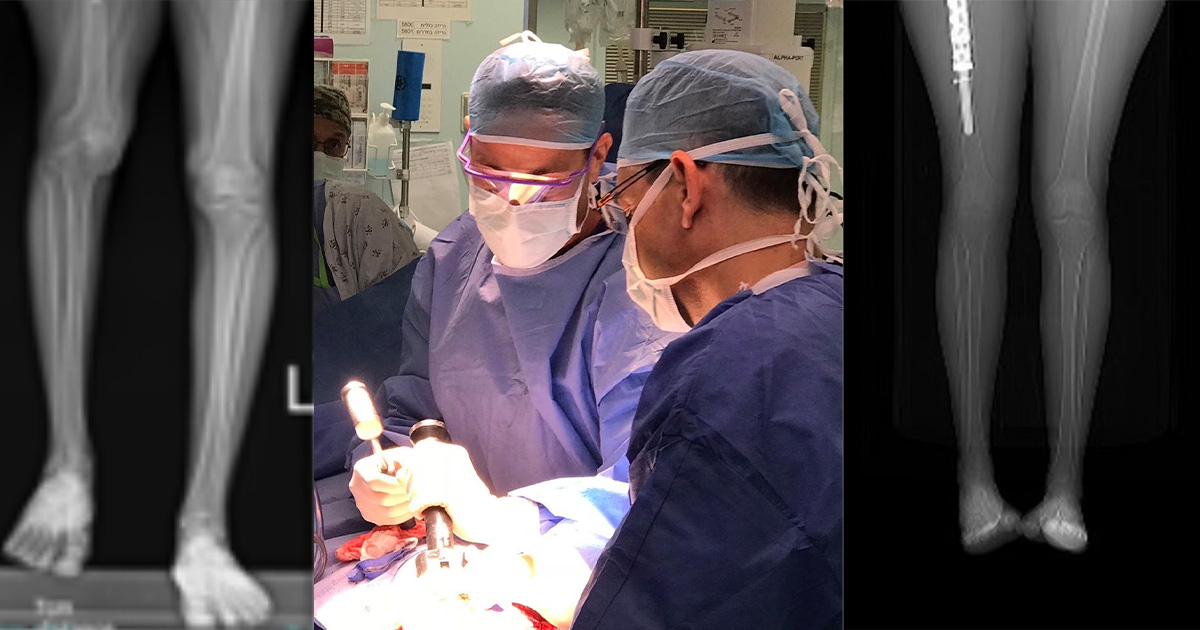
Over time, the replaced head of her femur collapsed into the pelvis, her leg shortened by about 10 centimeters and the pain became unrelenting. She had trouble walking and gradually found herself moving around in a wheelchair. Various hospitals in Israel tried to help, but no definitive answers emerged. She underwent comprehensive genetic testing and repeated evaluations, seeking multiple opinions until, finally, a diagnosis was made: vanishing bone disease, an exceedingly rare condition in which bone tissue is abnormally reabsorbed by the body and disappears for reasons unknown to medicine.
It is so rare that very few doctors encounter it during their careers. The disease carries a high risk of complications and ongoing uncertainty. Mira visited several hospitals in Israel but could not find a solution.
At this point, everything changed: Mira was referred, with a specific recommendation, to Dr. Omer Or, an expert in orthopedic oncology and metabolic bone diseases at Hadassah Hospital Ein Kerem — a complex medical field that few specialize in deeply.
After lengthy planning, the Hadassah expert made an unusual medical decision: to begin restoring the missing bones. The treatment was conducted in multiple stages over a year and required a comprehensive, precise plan. For the first surgery, in which Dr. Gurion Rivkin, director of the Joint Replacement Unit at Hadassah Hospital Mount Scopus, and surgical nurse Esti Friedlander also participated, two unique implants were designed and 3D printed. One implant reconstructed the missing pelvic bone and hip joint (ball-and-socket structure), and the other was a custom implant designed to replace the missing femur and gradually lengthen up to five centimeters. In a complex, hours-long operation, the doctors removed the old implant — which had migrated into the pelvis and was no longer supported by bone, as it had been almost completely reabsorbed — and reconstructed the hip joint and femur with the new custom implants. For the first time in years, the hip joint was restored to its place. In this rare surgery, which combined custom implant printing with full joint rehabilitation, the leg was lengthened by three centimeters.
Dr. Or explained that post-surgery, Mira used a specialized home device powered by a gentle electric current. She applied it to the implant lengthening site three times daily. With each session, the implant extended incrementally. Dr. Or noted this process is unique: not only does the metal lengthen, but muscles, tendons and soft tissue must “keep up the pace” and stretch accordingly.
"The original plan was to extend one millimeter per day over about 50 days — around five centimeters in total," explained Dr. Or. However, Mira's body responded better than expected. In the end, the leg was lengthened by an additional five centimeters after the operation, reaching a total of eight centimeters, followed by an intensive rehabilitation period."
A year later, Mira underwent her final surgery. Since extended implants tend to wear out over time, the temporary implant was replaced with a solid, permanent one. During this last operation, her leg was lengthened by another centimeter. At the end of the process, her leg nearly returned to its original length, and today she walks without crutches.
"This case is unusual not only because of the rarity of the disease but also because of the innovative solution found," concluded Dr. Or. It combined reconstruction of the pelvis and hip without bone, the use of a lengthening implant and coping with a disease in which the bone itself disappears. According to Hadassah Medical Organization staff, this is likely the first case of its kind in Israel."
This Israeli first was covered in The Times of Israel.