
.svg)


The Neonatal Intensive Care Unit at Hadassah Hospital Mount Scopus is decorated with colorful illustrations, a cheerful counterpoint to the serious work of caring for the tiniest patients. Doctors and nurses move attentively among the incubators, watching closely for every adjustment needed to help the small babies — some weighing only two pounds — grow and thrive.
Only the variety of head coverings and the soft murmur of parents speaking different languages hint at the diversity in the room. Families include Jews, Christians and Muslims, religious and secular alike. What they share is a common experience: a baby in the NICU, whether due to premature birth or medical complications. Either way, it is a deeply stressful time.
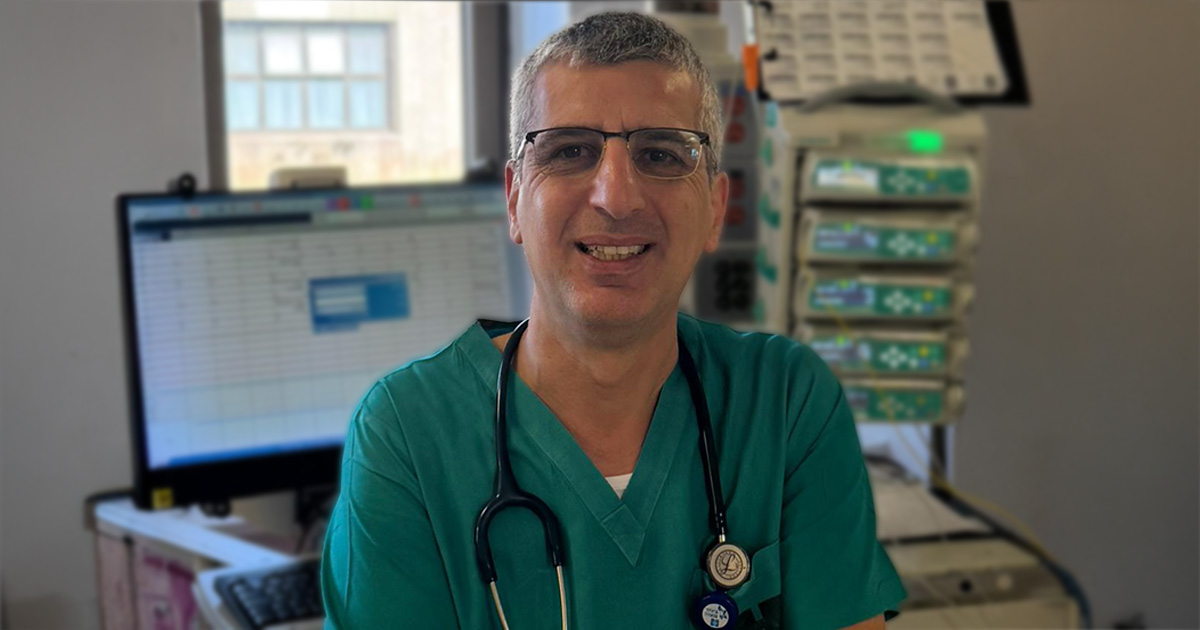
One person in particular helps ease that stress through his calm presence and compassionate approach: the head of the unit, Dr. Sinan Abu Leil. With graying hair and kind eyes, he checks on each baby, speaks with every parent and offers both professional guidance and emotional support.
Dr. Abu Leil studied medicine in Slovakia and completed his pediatric residency at Hadassah 22 years ago. He later pursued sub-specialization in neonatology at both Hadassah Hospital Ein Kerem and Hadassah Mount Scopus, becoming a senior NICU physician 13 years ago. He has led the Hadassah Mount Scopus NICU for over a year.
“We try to make difficult experiences better and easier,” Dr. Abu Leil said.
Parents remember him long after their NICU days are over. One such parent is Hayah, who gave birth to her daughter, Talya, now four, at 27 weeks. Talya weighed just two pounds when she was admitted to the NICU. During the 104 days her daughter remained hospitalized, Dr. Abu Leil included Hayah in his rounds and asked for her perspective on how Talya seemed to be doing.
“When doctors were discussing the possible need for heart surgery, Dr. Abu Leil called me in to be part of the conversation,” Hayah recalled. “‘The mom should hear all of the issues with the specialist from the very beginning,’ he said.”
“He empowers parents,” Hayah added. “He made me feel like a mother again by letting me take active care of my daughter. I bathed her and advocated for her.”
One moment captures Dr. Abu Leil’s approach especially well. When Talya cried and kicked as nurses struggled to find a vein, he took a different path, gently rocking the baby, calming her enough to successfully insert the IV.
“Everyone loves him. He’s a mensch,” Hayah said, using the Yiddish word for a deeply empathetic person.
Another mother, whose baby was admitted to the NICU following surgery, recalls Dr. Abu Leil’s attentiveness and willingness to go above and beyond. Recovering from surgery herself, she was hospitalized on a different floor and could only move by wheelchair. As Rosh Hashanah approached that fall, she feared she would not be able to see her baby, since using a Shabbat elevator was too difficult. After seeing that the baby’s condition had improved, Dr. Abu Leil arranged for the infant to be moved closer to the mother in time for the holiday. “I’m grateful that he saw both the mother and the child,” she said.
A father of four, Dr. Abu Leil chose neonatology because of his love for children and his interest in intensive care medicine. The NICU, he said, offered the perfect combination of both.
At Hadassah Mount Scopus, he leads a diverse team of senior doctors, interns and nurses, along with paramedical staff such as social workers and physiotherapists.
“Taking care of a small baby is complex,” he said. “Without teamwork, we wouldn’t be able to function in the NICU.”
Support for families begins even before birth, when physicians explain possible complications. After delivery, doctors clarify the situation for parents and involve social workers to provide emotional and practical support.
“The team forms strong connections with families,” Dr. Abu Leil said. “They tell us they trust us. The relationships often last for years, with parents sending photos of their children. It’s very emotional.”
While caring for the hospital’s tiniest patients is demanding, it is also deeply rewarding. “Our work is challenging, but seeing positive outcomes brings us joy. We do everything we can to save lives.”
Currently in the NICU is a 37-day-old baby born at 23 weeks, weighing just 1 pound, 4 ounces.
“I am constantly amazed by how strong these tiny babies are and by the strength of their families,” Dr. Abu Leil said.

.jpg)