
.svg)


Abdominal pain is one of the most common complaints in pediatric medicine. In most cases, it is a transient phenomenon, but at times, the pain signals a deeper underlying problem. This was the case for Noor, an 8-year-old girl living with her family in Jerusalem, who repeatedly presented to physicians with severe upper abdominal pain and difficulty eating — without a clear diagnosis.
The girl, who comes from a family of six children, suffered from intense pain for several weeks. Following repeated complaints, her parents took her for further medical evaluation. Initially, she was examined by a pediatrician at her health maintenance organization, who identified abnormal liver enzyme levels.
When ongoing medical follow-up failed to explain her condition, she was referred for further diagnostic workup, including an ultrasound examination. Once a bile duct cyst was suspected, she was referred to Hadassah Hospital Ein Kerem, where she completed the diagnostic process and underwent an innovative robotic surgery — the first of its kind in Israel.
Dr. Ashraf Imam, a senior surgeon specializing in liver, pancreas and bile duct surgery in both children and adults and director of the Liver Transplant Service at Hadassah hospitals, explains that a bile duct cyst is an abnormal — usually congenital — dilation of the ducts that carry bile from the liver to the digestive system. This condition disrupts normal bile flow and may cause pain, infections and cumulative liver damage.
“This is a medical finding that does not allow for prolonged delay,” said Dr. Imam. “Without treatment, bile duct cysts can lead to recurrent infections, progressive destruction of liver tissue, development of cirrhosis and even bile duct cancer later in life.”
“When they told us what it was, I was extremely frightened,” the girl’s mother recounted. “The thought of the liver, surgery and future complications was terrifying. But then the team explained in great detail the surgical approach they had chosen. We understood that this was a new procedure in Israel, and despite the fear, I truly trusted the team. I know that at Hadassah Ein Kerem, there are the very best experts. The explanations and conversations beforehand really reassured us.”
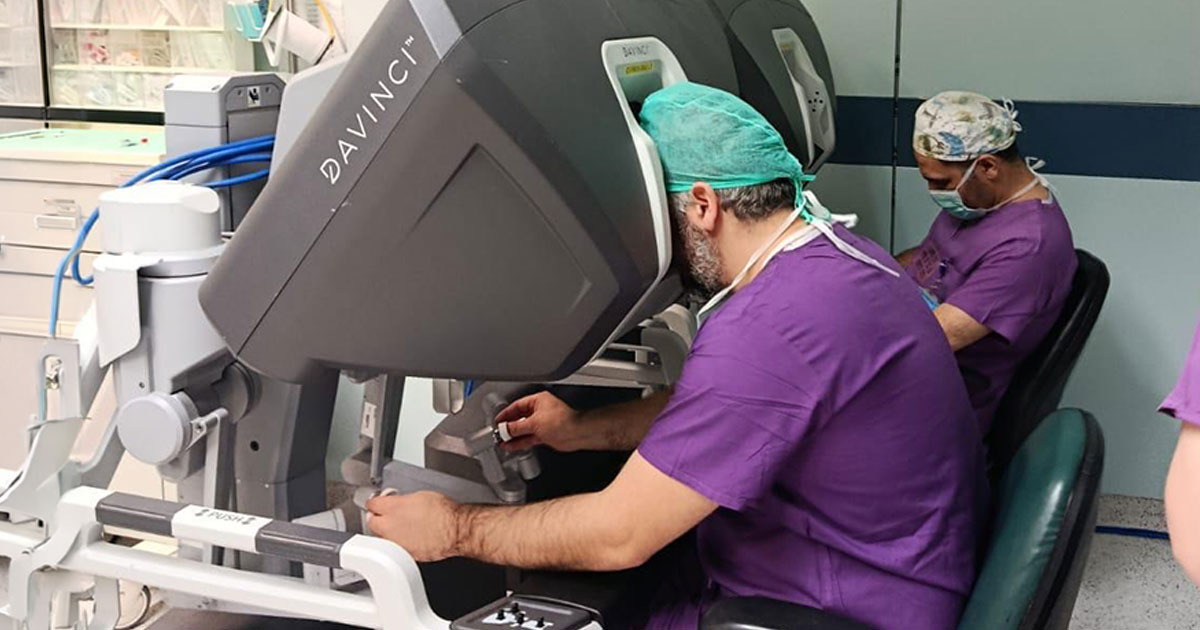
Noor’s medical team decided to remove the cyst using an advanced and innovative approach: instead of open surgery, which involves a large incision, significant pain and prolonged recovery, a minimally invasive robotic-assisted technique was chosen, performed for the first time in Israel.
Robotic surgery is a minimally invasive surgical method performed through several small incisions in the abdominal wall. Through these incisions, a camera and robotic arms are inserted, allowing the surgeon to view the internal organs and operate with great precision. The technique results in less pain, fewer complications and smaller scars compared to open surgery. Recovery time, emphasize physicians in Hadassah hospitals’ pediatric surgery team, is shorter, and the return to a normal routine is faster.
“While in most parts of the world these operations are still performed using the open approach, which requires a much longer recovery period and involves higher risks, at Hadassah Ein Kerem the procedure has undergone a significant and highly advanced transformation,” explained Dr. Imam. “We have the capability at Hadassah hospitals to perform very complex surgeries, particularly in children, where the challenge is greater due to the smaller anatomical working space.
“This new type of surgery is completely changing the world of medicine, particularly surgical capabilities,” he stressed. “Pain and recovery following open surgery are extremely difficult, all the more so for children.”
During the operation, the robot is fully controlled by the surgeon and allows for exceptionally high precision, delicate movements and magnified three-dimensional visualization — features that are critical in delicate bile duct surgeries.
“In the operating room, we perform a complete excision of the bile duct cyst and the gallbladder while preserving the blood vessels supplying the liver. The procedure also includes reconstruction of the bile ducts, which is a very essential part of the operation. The reconstruction creates a new, proper pathway for bile flow from the liver to the digestive system, enabling long-term normal liver function,” Dr. Imam explained.
“Several years ago, we performed this operation for the first time in Israel here at Hadassah hospitals using the laparoscopic approach,” said Dr. Diaa Zghair, head of the Pediatric Laparoscopic Surgery Unit and one of Noor’s surgeons. “This method is significantly more advanced and preferable to open surgery. Minimally invasive procedures require a higher level of skill, and thanks to the expert physicians at Hadassah hospitals, the advanced medical equipment, and now also the introduction of surgical robots for the first time in pediatric operating rooms, we have the capability to perform these procedures successfully.”
The second case treated by the team involved a 17-year-old boy from Jerusalem, who also suffered from recurrent abdominal pain. At first, his family thought the pain was ‘routine,’ but when it kept recurring, they sought medical evaluation and were referred by their health fund to Hadassah hospitals’ specialists. When they came to Dr. Imam, following diagnostic tests, he informed them — to their great relief — that the surgery could be performed using the innovative robotic approach, which allows for a shorter and more comfortable recovery.
Dr. Dan Arbel, head of the Department of Pediatric Surgery at Hadassah Ein Kerem, highlighted the future vision of the field: “Robotic-based technology enables more precise and safer procedures, with minimal harm to the body. This surgery demonstrates Hadassah hospitals’ uniqueness in enabling innovative methods through interdisciplinary collaboration to provide optimal care for every patient.”
His remarks underscore the spirit of the department, as the day after the first robotic surgery of its kind in Israel, a second successful robotic operation was performed at Hadassah hospitals on the 17-year-old patient.
One day after her surgery, Noor was already back on her feet and feeling well. Typically, patients undergoing such operations are transferred to intensive care, but with this method, the girl spent only three hours in recovery before being transferred to the pediatric ward and was discharged home shortly thereafter.
“In the pediatric population, a choledochal cyst in the liver can cause life-threatening inflammation of the liver and bile ducts, leading to prolonged hospitalizations and significant loss of school days,” concluded Dr. Zghair. “The robotic approach is preferable even to laparoscopy because the surgical field is visualized in three dimensions, allowing the surgeon to operate from different angles through the same incision.”
“I’m very happy that I chose to trust the medical team,” Noor’s mother said with a smile. “My daughter was back on her feet one day after surgery, after months of suffering when we didn’t know how to help her.”