
.svg)


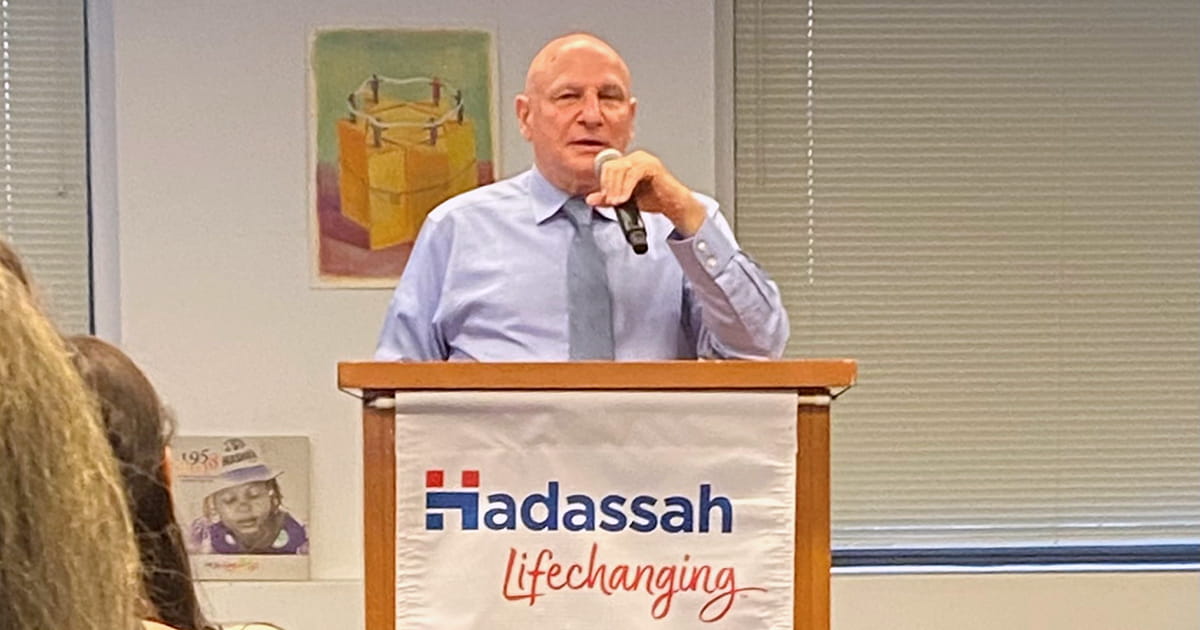
From artificial intelligence and personalized cancer treatments to organoids, robotics and advanced rehabilitation, Hadassah Medical Organization (HMO) Director General Prof. Yoram Weiss, MD, offered an inside look at the innovative work happening today at Hadassah hospitals in Israel during a recent visit to Hadassah’s national headquarters in New York.
Speaking to Hadassah staff, Prof. Weiss shared some of the latest advances underway at Hadassah hospitals in Jerusalem and offered a glimpse of what comes next as HMO continues to expand its medical, research and technological capabilities. He spoke of HMO’s mission, stressing its commitment to training and teaching and to serving as a bridge to peace. “We’re doing that every day, every moment,” he said.
Among the advances Prof. Weiss highlighted was HMO’s growing leadership in robotic surgery. Hadassah hospitals played an early role in the development of the Mazor Robotics Renaissance® Guidance System for spine surgery and today is working closely with Medtronic on the development of its Hugo robotic-assisted surgery (RAS) system.
HMO’s expertise has also made it a sought-after partner for some of the world’s leading healthcare and technology companies. HMO works with GE HealthCare on advanced imaging and theranostics and with Roche Pharmaceuticals on personalized cancer medicine, drawing on the hospitals’ extensive clinical data and artificial intelligence capabilities.
Prof. Weiss also pointed to HMO’s work with organoids, tiny three-dimensional models grown from patients’ cells. Hadassah hospitals are already using organoids to help determine which treatments are most likely to work for patients with cystic fibrosis, helping to identify the right medication for each individual. “We’re giving better medicine to the patient much faster,” Prof. Weiss said. “No more trial and error.” As part of its commitment to global cooperation and teaching, Prof. Weiss noted that HMO researchers are leading a monthlong hands-on training course in Massachusetts this summer to share expertise with medical researchers and students from around the world.
He also highlighted HMO’s expanding work using artificial intelligence. “We are in the middle of a revolution when it comes to medical management,” Prof. Weiss said. Already, physicians are working with an AI system in their routine work.
Drawing on computerized medical data — HMO started early, in the 1980s — Hadassah has brought together genomic, laboratory, clinical and imaging information to create a “data lake,” giving physicians a tool to better understand individual patients and how to tailor their care. That’s one reason the pharmaceutical company Roche chose Hadassah as one of a handful of hospitals worldwide collaborating on an initiative related to the genetic identification of cancer, Prof. Weiss said.
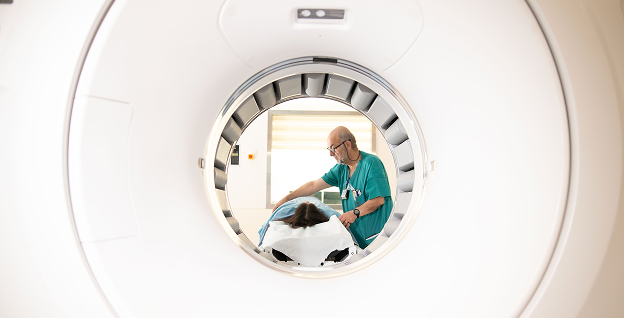
Other advances include HMO’s work in CAR-T cell therapy, theranostics, 3D printing and robotic surgery. HMO is developing what Prof. Weiss said will be Israel’s largest robotic surgery center and is the first hospital outside the United States set to implement the Ion robotic bronchoscopy system, which can reach deep into the lungs to obtain biopsies.
But amid a presentation filled with medical breakthroughs and technology, Prof. Weiss repeatedly returned to what he considers Hadassah’s greatest strengths: our people and our mission.
Hadassah hospitals treat about 1 million patients each year, serving Jerusalem’s extraordinarily diverse population.
“When they come to Hadassah, they feel that Hadassah is a place for healing, and that they can come to Hadassah and feel safe,” Prof. Weiss said.
The hospitals are also a place where staff model coexistence. Hadassah trains and employs physicians and nurses from around the world, including approximately 70 fellows from the Palestinian Authority.
HMO medical teams provide humanitarian care internationally, including at a clinic on the Ukraine-Poland border that treated some 35,000 people following Russia’s invasion of Ukraine.
“Hadassah, in a way, is a bubble of peace within the havoc of the Middle East,” Prof. Weiss said.
Looking ahead, HMO is developing a 10-year plan for its Jerusalem campuses as it continues investing in new facilities, technology and the next generation of medical professionals.
Prof. Weiss emphasized that all of those advances depend on the people behind them, the physicians, researchers, nurses and staff who bring Hadassah’s mission to life every day.
And as HMO plans for what comes next, he said the goal is clear: “We need to have a dream. We need to look to the future.”