
.svg)


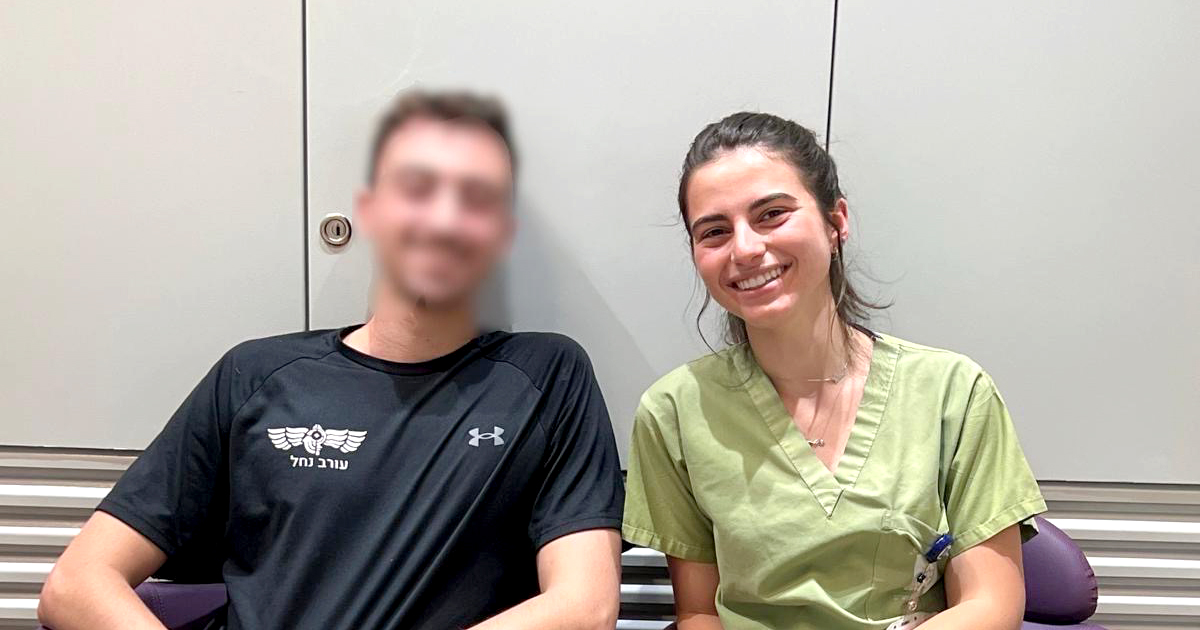
What began in the corridors of the Gandel Rehabilitation Center at Hadassah Hospital Mount Scopus — when Avital, a young national service volunteer in the Occupational Therapy Unit, and Staff Sergeant (Sgt.) Yehuda, a severely wounded soldier undergoing rehabilitation — turned into a moving love story that captured the hearts of the entire medical team.
“The Hadassah staff supported and encouraged us every step of the way. They were truly like a family to us.”
The Gandel Center was established with the goal of returning patients to their lives as quickly as possible — strengthened, and having regained abilities lost due to injury or surgery. Since its rapid-opening operation at the outbreak of the war, created to treat the severely wounded from the north and south, more than 2,000 patients have already undergone rehabilitation within its walls — civilians and soldiers alike. Many still arrive daily for intensive rehabilitation, including physiotherapy, occupational therapy, hydrotherapy, speech therapy, psychological support and even complementary medicine.
Amid intense training sessions and therapy guided by a professional team that instills tremendous motivation in the recovering soldiers, a touching love story developed between Yehuda, an IDF soldier severely injured in Gaza undergoing intensive rehabilitation, and Avital.
Avital Schmeltz, 21, immigrated to Israel from the US in 2023, hoping to learn Hebrew and contribute to the country. After a year of studies in a midrasha (women’s seminary), she began her national service — initially assisting evacuees from the south at the Cramim Hotel and later transferring to the Occupational Therapy Department at Hadassah Mount Scopus, where she feels she is contributing and thriving.
“I didn’t know anything about the field and was a bit nervous to enter it,” she recalls. “In the end, I found myself connecting with the staff, enjoying the work and making a real impact on the patients.”
There, among the numerous patients, wounded soldiers began arriving for treatment; after surgeries and procedures, they entered the challenging rehabilitation stage. Among them was Yehuda, then 22, a Jerusalem native who served in the Nahal Reconnaissance Unit and was severely injured in January 2025.
“We were on an operation in Beit Hanoun,” Yehuda recalls. “We entered a building that had a hidden camera. It turned out there was an explosive device inside the wall. They saw us on the camera and on our way out, detonated the device. I fell instantly. Everything around me was on fire. I suffered severe burns to my arms, hands, face, neck and especially my leg. I had a head injury and lost consciousness for some time,” he continues. “Luckily, my friend ran in and saved me.”
Yehuda and his friend were hospitalized together at Hadassah Hospital Ein Kerem under the care of the Burn Unit and later transferred to the Gandel Center.
Dr. Sheer Shabat, a specialist in physical and rehabilitation medicine who treated Yehuda, explains:
“The main focus of Yehuda’s rehabilitation was treating the burns, closing the wounds and managing the intense pain that accompanies burn injuries. These challenges affect sleep, basic mobility and almost every action.”
She adds that Yehuda and his friend, hospitalized together from the start, “were like a duo — encouraging and pushing each other forward.”
Later, Yehuda’s friend recovered and returned to combat duty, while Yehuda remained for continued treatment, much of it centered around occupational therapy.
Dr. Shabat explains that occupational therapy consists of three main components: “The cognitive aspect, the sensory–motor aspect and the functional aspect. After strengthening physical abilities, we translate them into daily function: independent dressing, bathing, eating and more.”
The department includes special treatment rooms and assistive tools. “We have a room that simulates an apartment with a kitchen, laundry rack, bathroom, bedroom and even a baby-changing area to help patients practice returning to everyday tasks. Later, we move to advanced functions, such as cooking or household chores. We even built a ‘supermarket’ to simulate life outside the hospital and a driving simulator for practicing returning to driving. For soldiers, we have weapon-handling simulations as well.”
It was there, in the Occupational Therapy Department, that Yehuda and Avital first crossed paths.
“I usually interact daily with most patients,” Avital says, “but I almost never saw him. When we finally met, it was completely by chance.”
Time in the rehab center brought them closer. Short conversations grew longer, and within the hospital routine, a connection formed — one neither of them had expected.
“What began between the hospital corridors — me as a young volunteer and him as a wounded soldier — became a story that touched everyone around us.”
“Yehuda didn’t know I was religious as well,” Avital explains. “He was surprised when he heard I studied in a midrasha, and that’s when he became more curious.”
Avital shares a sweet anecdote. Her father, who lives with her mother in the US, joked when she began her service at Hadassah Mount Scopus:
“He would say, ‘What, there aren’t any nice soldiers there?’ And I would hush him, tell him to stop embarrassing me.”
“The staff at Hadassah also started teasing us,” she laughs. “I dismissed it; these things don’t really happen in real life.”
But reality proved otherwise. “I found myself walking the corridors with a friend, hoping to run into him. I’d wonder each morning if he had arrived and how he was feeling.”
After a long period of hospitalization, Yehuda was ready to be discharged and continue rehabilitation in outpatient care.
“At the end of his discharge celebration, we were alone for a few moments, and suddenly he hinted that he was interested,” she recalls. “He asked if I wanted to keep in touch. I was completely unprepared.”
“I had thought about it,” Yehuda admits, “and at that moment I decided I had nothing to lose. I forgot that I’d be seeing her again anyway during outpatient rehab,” he laughs.
Avital describes her initial response: “I panicked at first. I told him I wasn’t sure, that I was studying for my psychometric exam and was only free on weekends.” He gave her his number. “I needed a few days to process it. And then I messaged him.”
That led to their first date — and many more.
Their bond grew stronger, and soon conversations about marriage began.
“I brought up the idea and asked her how she felt,” says Yehuda.
“Yehuda gave me time to think and process,” Avital says. “I realized he’s the one. I feel safe with him — he makes me laugh. We worked hard on our communication. I understood there’s no reason to wait.”
After nearly five months of dating, the couple got engaged — filling their families, friends and the rehabilitation team with joy.
“When I called my dad and told him, he laughed and said, ‘See? I was right!’” Avital smiles. “I wasn’t even supposed to extend my national service at Hadassah for a second year. It happened at the last minute. And thank G-d it did, because that’s how I met Yehuda.”
Yehuda agrees: “It’s true I was injured, and the rehabilitation was long, but something incredible came out of it. Sometimes what seems like a setback is actually for the best.”
Today, Yehuda has recovered and returned to full function. After the wedding, he plans to work in carpentry. He still returns periodically to the center where his life changed and where the team continues monitoring his recovery.
“Now I return to the department as the wife of one of the patients — the same department where I arrived every morning for national service. It’s a very special feeling,” Avital shares.
“The Hadassah staff encouraged and supported us the entire way. They were like a family.”
Dr. Shabat attended their wedding. “It was incredibly moving to see them get married after their relationship began during rehabilitation,” she says. “Avital is wonderful. She’s kind, warm and eager to learn and help. And Yehuda is truly the finest of our country. May we merit many more like him.”