
.svg)


Like many young Israelis after completing their military service, Maya Avnun, 21, from Jerusalem, set out on a long-awaited backpacking trip with a close friend.
After months of saving money and planning a multi-country route, she never imagined that her journey would end with an emergency airlift back to Israel for spinal surgery at Hadassah hospitals — a fateful decision that most likely saved her from permanent paralysis.
Maya and her friend had been traveling for several months before arriving in Guatemala. Like many Israeli travelers, they participated in various attractions, some more extreme than others. “We reached a site where people jump from a fairly high cliff into a lake,” Maya recalled. “It’s a very well-known attraction that everyone does in an organized park. At first, I was very scared and even told myself there was no way I was jumping. But everyone else jumped and came out fine, so I told myself I couldn’t miss the experience.”
Maya gathered her courage and jumped from a height of approximately 43 feet into the lake. When she hit the water, she immediately felt something was wrong. “I landed in a seated position and instantly felt severe pain in my back. I managed to get my head above the water, but I realized something wasn’t right because I couldn’t move my body to swim,” she said.
For several minutes, park staff struggled to rescue Maya from the water. “Those were terrifying moments,” Maya said. “At first, people outside didn’t understand that something was wrong. With great difficulty, I managed to get myself out of the water, but to leave the area completely, you had to climb, and I couldn’t do that. Everyone was looking at me and didn’t know what to do.”
The rescue took a long time, and many hours passed before Maya received medical attention. “Throughout that entire time, I couldn’t move my body,” she said. “I tried to detach myself from the situation so I wouldn’t panic too much.”
She remained in severe pain until she was finally admitted to a medical center capable of treating her. At the hospital in Guatemala, doctors decided she required immediate emergency surgery.
Rama, Maya’s mother, describes the phone call the family received: “Maya contacted us from the local hospital. With the help of a translator, we spoke with the doctors, who told us that Maya had sustained a fracture in a very complex area of the spine, close to critical neural structures. They already spoke of neurological damage — that her legs were weakening and that there was a high likelihood she might not be able to walk again. These were incredibly difficult moments for us, especially being so far away from her.”
While Maya was already being prepared for surgery in Guatemala, her parents decided to consult Dr. Josh Schroeder, head of the Spine Surgery Unit at Hadassah hospitals, before making the critical decision. “The doctors in Guatemala made it seem as though there was no choice but to proceed with emergency surgery, with a high risk of paralysis in her legs,” Rama said.“By what felt like a miracle, we managed to reach Dr. Schroeder just two hours before Maya was supposed to be taken into surgery,” she continued. “We held a conference call with Maya. He asked her questions about her neurological function and reviewed videos showing slight movement in her legs. He reached a clear conclusion that she must be urgently airlifted to Hadassah hospitals in Israel.”
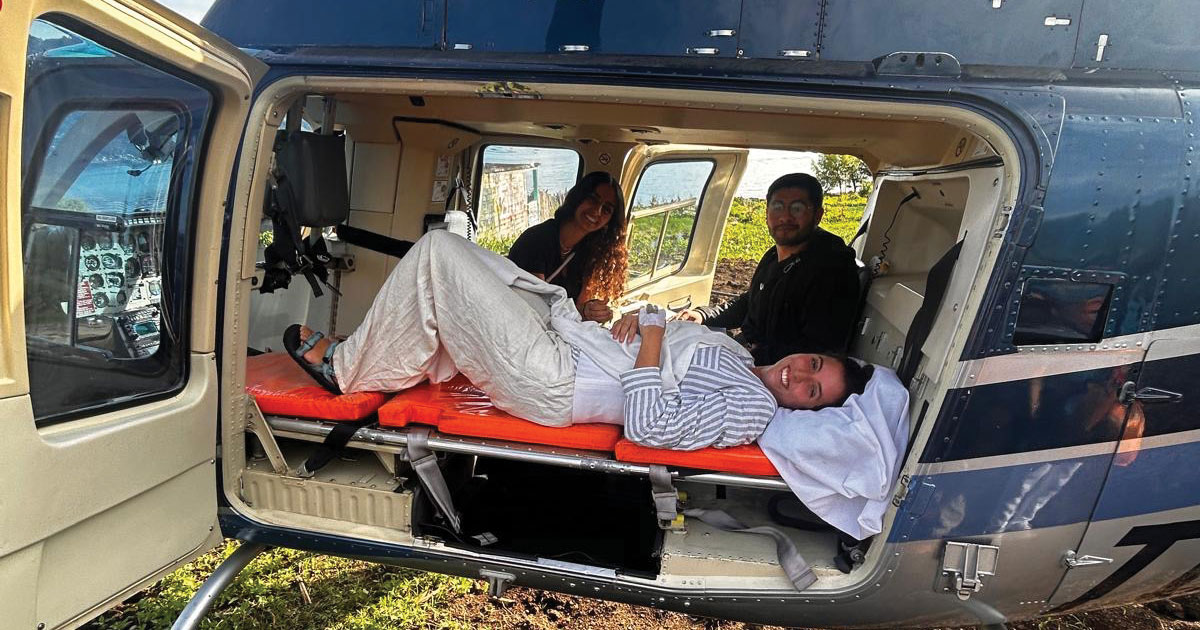
Maya was flown to Israel on a medical evacuation flight and arrived at Hadassah Hospital Mount Scopus, where Dr. Schroeder and the operating room team were already prepared to receive her. “After reviewing the videos the family sent, I understood that Maya was sufficiently stable for transport and decided she should be flown to Israel,” Dr. Schroeder explained. “She arrived at Hadassah Mount Scopus with a comminuted fracture of the spine, and the major concern was that she could become paralyzed in her lower body.”
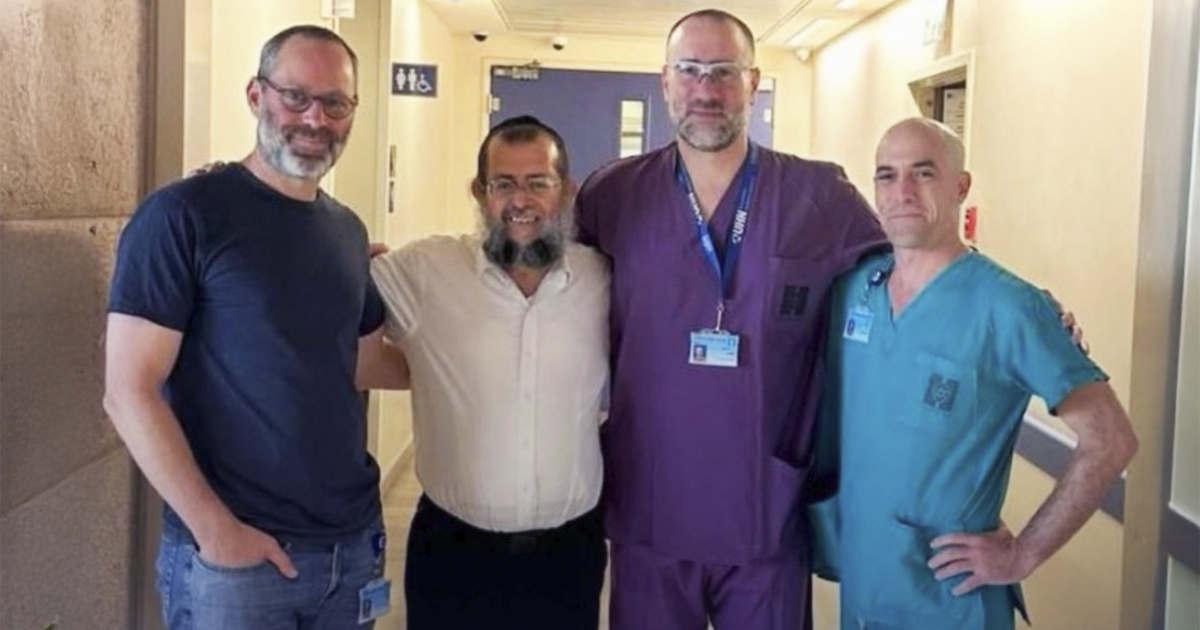
Using advanced instrumentation and robotic technology in a minimally invasive approach, Dr. Schroeder and Dr. Ohad Einav of the Orthopedic Department, together with anesthesiologists Dr. Marina Weitman and Dr. Ahmad Badr, stabilized the spinal vertebrae and prevented the risk of paralysis. “During the surgery, together with Dr. Einav, we stabilized the vertebrae in an area composed of very delicate, tiny bones,” Dr. Schroeder explained. “It was even clearer to me that this surgery could not have been performed in Guatemala. Without the technology available at Hadassah hospitals and the expertise we have here, it would not have been possible to carry out the procedure without causing severe damage to Maya’s function, and the likelihood of permanent paralysis would have been significantly higher.”
Following her recovery from surgery, Maya was transferred to the Gandel Rehabilitation Center at Hadassah Mount Scopus, where she is undergoing an extensive rehabilitation program aimed at restoring the full abilities she lost.
“We were incredibly fortunate that we had that conversation with Dr. Schroeder,” Rama said. “He is like Maya’s guardian angel. Throughout this entire period, we were under unbearable tension; we didn’t know whether our daughter would be able to walk again. I feel we made the right decision to airlift her to Hadassah hospitals. We are filled with gratitude to Dr. Schroeder, who was able to assess Maya professionally even from afar and then successfully operated on her together with Dr. Einav.” Rama continued, “They put her back on her feet. We are also deeply thankful to our family and friends who supported us through such difficult moments.”
Dr. Schroeder believes that Maya is expected to make a full recovery. “Maya’s surgery was successful, and after completing rehabilitation, she will be able to walk normally and function as she did before the injury,” he said. “She may even be able, if she chooses, to return and complete her post-army trip."