
.svg)


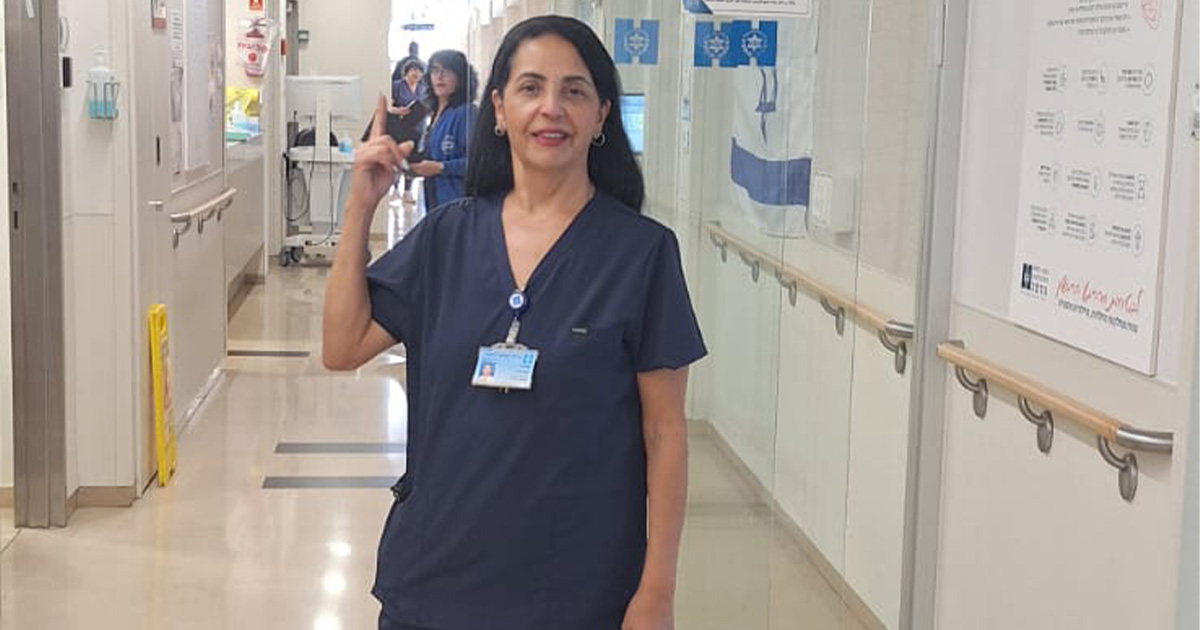
Thanks to her ongoing training at Hadassah Hospital Mount Scopus, veteran nurse Avivit Eliyahu sprang into action when a fellow passenger collapsed during a flight from Ethiopia to Israel, performing lifesaving procedures and helping to save his life.
Avivit boarded what she thought would be a routine flight home from Ethiopia to Israel. She had no idea that the journey would turn into a dramatic, lifesaving event in which she would put into practice the knowledge she had accumulated over decades of work at Hadassah hospitals.
After 38 years at the hospital, most of them as a nurse in the maternity ward, she had just returned from a 12-day jeep tour with a regular group of travelers she describes as having long since become like family. The quiet days in nature stood in sharp contrast to her daily demanding, fast-paced shifts in Maternity Ward C.
Midway through the flight, shortly after the meal was served, one of the passengers noticed something unusual. A man of about 75, seated a row ahead, was slumped in his seat with his head tilted at an unnatural angle. He was unresponsive, and strange sounds were coming from his mouth.
“She was the first to notice,” Avivit recalled. “At first, he seemed stable, and then he began to gasp. Two young passengers sitting next to him were asleep and didn’t realize that anything was wrong.”
Almost immediately, the familiar announcement was heard over the intercom: “Is there a doctor or nurse on board?” Avivit did not hesitate.
“I got up right away. It’s instinct. I’m a nurse everywhere, even on vacation. When you hear the call, you’re already there.”
When she reached the passenger, the situation was clear to her.
“I connected the dots very quickly. It was right after the meal, and he was unresponsive. I realized he had likely suffered partial choking, and food had entered his airway.”
Checking his pulse, she found it was extremely weak, almost imperceptible. Time, she knew, was working against him, and every minute was critical.
Without medical equipment and without proper conditions, but with experience and determination, she began to act.
“I asked the two young passengers sitting next to him to help lay him down on as firm a surface as possible. I began clearing secretions from his mouth, checking his pulse and assessing his condition. It was truly a field situation.”
The flight attendants gathered around her, alert and anxious. Questions were raised: Should the plane make an emergency landing? Would it have to land in Saudi Arabia? Should they wait?
“These are split-second decisions,” Avivit said. “I focused on the task at hand. First and foremost, you have to decide how to save a life.”
She asked those around her about the man.
“According to the people near him, he was traveling alone. His son had put him on the outbound flight from Israel to Ethiopia to visit family and was apparently waiting for him in Israel on the return.”
As the man was unconscious, Avivit began chest compressions, suspecting partial choking and attempting to dislodge food that may have been stuck in his airway. The action was a precise and calculated procedure learned and reinforced time and again in CPR and resuscitation courses.
“At Hadassah hospitals, a professional resuscitation system conducts CPR training and regular refresher courses for the teams. In moments like these, every review of the material saves lives quite literally.”
After minutes that felt like an eternity, “suddenly he opened his eyes. There were signs of life. It’s a moment of immense relief, but also of great responsibility — because it’s not over yet.”
Avivit mobilized those around her, assigned roles and continued to monitor the passenger closely.
“Everyone was given a task. Everyone wanted to help.”
The man began to move his lips, but appeared very confused.
“I suggested that if people speak to him gently in Amharic, it might help orient him. But he was disoriented and didn’t really understand where he was.”
Throughout the incident, Avivit did not leave the passenger’s side.
“I didn’t leave him for a moment until he was stable. I was genuinely worried about his condition. There’s always the fear that you won’t succeed or that the situation will deteriorate.”
After she updated the captain that the man’s condition had stabilized, the captain decided to continue the flight. The passenger remained under observation until landing. Fellow passengers approached Avivit, thanked her and praised her actions.
“It was very moving but also exhausting. The sense of responsibility stays with you throughout the flight, and physically you’re working nonstop.”
The pilot personally thanked Avivit, praising her composure and professionalism. Yet when the plane landed, the story, at least for her, was not over.
“When I got home, I didn’t sleep all night. I was overwhelmed,” she said. Reflecting just hours after the incident, she added:
“There is no real preparation for saving a life. It’s an incredible feeling. What matters most to me is that people understand the importance of the practical side of training, the knowledge and the hands-on practice — even when you think you already know it. I’m not saying this to pat myself on the back, but because practical knowledge is something I invest in, and I never imagined it would one day make such a difference.”
After 38 years as a nurse at Hadassah hospitals, Avivit refuses to turn the moment into a personal drama.
“I simply did what needed to be done. I’m a nurse,” she concluded modestly.