
.svg)


At Hadassah hospitals, Drs. Stav and Lea Sarna Cahan are known not only for their clinical excellence but for the way their professional lives and personal partnership intersect — in crisis, in routine and in moments that test the limits of medicine itself.
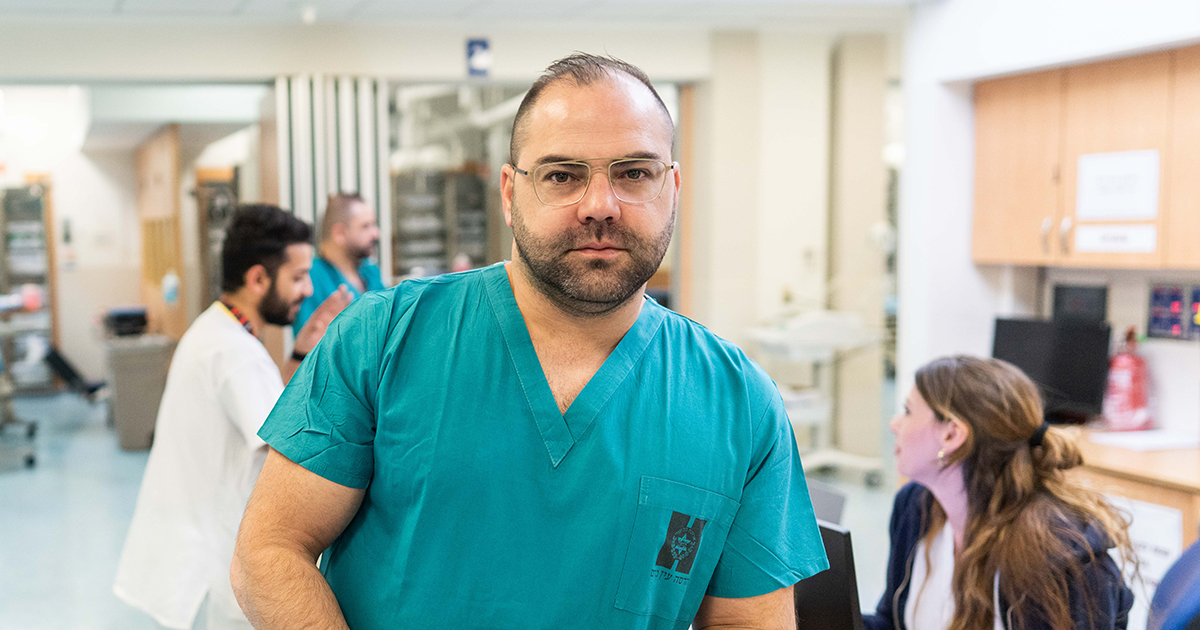
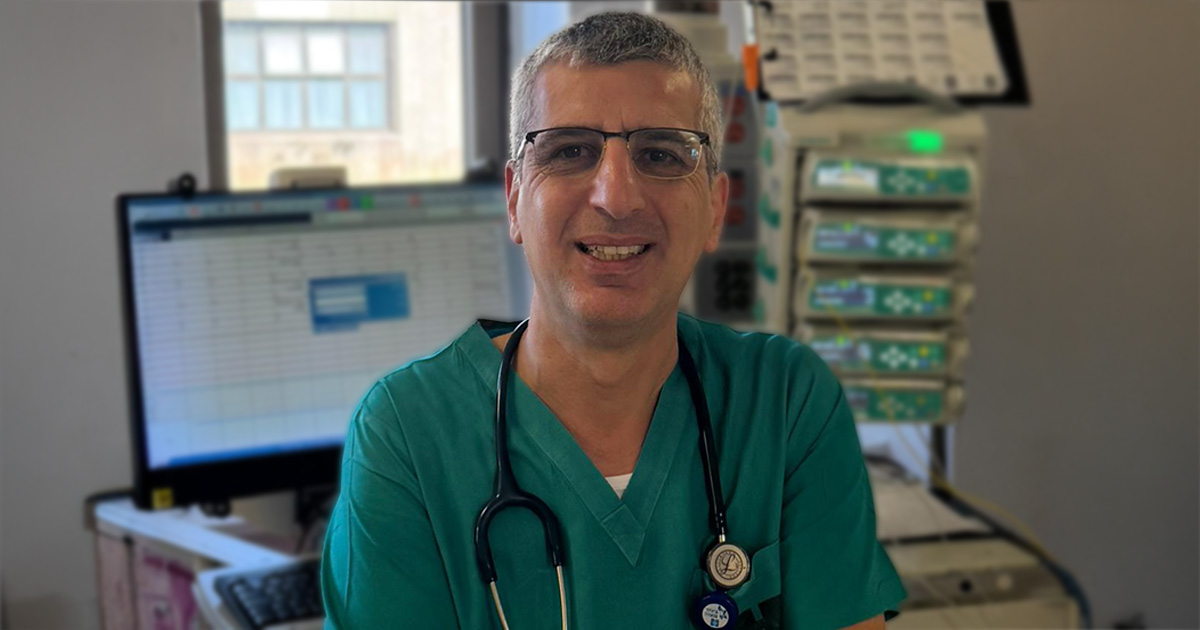
Married for 20 years and raising two young sons, the Sarna Cahans lead two of the Hadassah Medical Organization (HMO)’s most demanding medical fronts. Stav, 44, heads the Burns Unit at Hadassah Hospital Ein Kerem. Lea, 41, is a pediatric emergency medicine specialist. Together they form what colleagues call a Hadassah power couple, united by a shared mission, relentless schedules and an ability to show up when they are needed most.
That mission took Lea far from Jerusalem in 2025, when Hurricane Melissa tore through the Caribbean, devastating Jamaica and overwhelming its hospitals. Named the third-most intense Atlantic hurricane in history and the strongest tropical cyclone worldwide that year, Hurricane Melissa left catastrophic damage in its wake. Israel’s Ministry of Health dispatched thirty doctors and nurses into the storm zone, among them Lea, representing HMO.
At Mandeville Regional Hospital’s Accident and Emergency Department, which had become an overcrowded hub after nearby hospitals collapsed, priorities were clear: child and maternal health, emergency care and preventing the spread of disease. Alongside HMO nurse Mor Ben-Simon and local medical teams, Lea treated wounds and fractures and carried out resuscitations under conditions of severe scarcity.
“It was eye-opening to see how you can provide good care with limited resources,” she said. “Everything I learned at Hadassah hospitals gave me the tools and the ability to think out of the box.”
One young patient, a boy struggling to breathe after losing his asthma medication in the hurricane, left a lasting impression. After receiving treatment and being monitored, he was discharged within hours. Before leaving the crowded hospital, he searched for Lea, spotted her across the room and called out, his breathing restored: “Hey! Israel! Thank you!”
Back in Jerusalem, the Sarna Cahans’ partnership is tested regularly. In June 2025, when the war with Iran began, both were on call. Lea was summoned first to evacuate the emergency room. Stav was called later, managing to pick up their two sons, ages 11 and 7, and bring them to the hospital. “We all camped in the office,” Stav recalled. Working at the same institution, he noted, made an already complex situation manageable.
“Our jobs are so demanding, you take a lot of it home,” Lea said. “It makes it easier to share the experiences.”
Their story began years earlier, when a mutual friend introduced them as medical students in Budapest, Hungary, both searching for roommates. Though they had attended the same high school, Mae Boyer High School, they had never met. “We had great chemistry from the beginning,” Lea said. What started as shared housing soon became a life partnership. “I found my best friend,” she added.
Both always knew they wanted to become doctors. Lea served as a paramedic in the IDF, while Stav grew up in a household of physicians. Their professional paths eventually converged at HMO, where Lea began her internship in pediatrics and gravitated toward the fast pace and complexity of the emergency room. Stav found his calling in plastic and reconstructive surgery after witnessing an especially impressive procedure.
In 2022, the couple and their children spent a year in Boston, where both completed fellowships — Lea in disaster medicine at Beth Israel Deaconess Medical Center and Stav in acute and reconstructive burn care management at Massachusetts General Hospital, as well as pediatric burn care at the Shriners Hospital for Children. “It was a great year professionally, personally and for us as a couple,” Lea said. Their sons thrived as well.
Today, much of Stav’s work has focused on treating soldiers injured since the October 2023 war. He treats both soldiers and civilians with severe blast injuries at HMO, a primary center for hundreds of soft tissue injuries and burns. Care includes advanced techniques such as enzymatic debridement, skin grafts, laser therapy and hyperbaric treatment, delivered through a multidisciplinary approach that incorporates psychological care and nutrition. Many patients continue rehabilitation at the Gandel Rehabilitation Center at Hadassah Hospital Mount Scopus, where Stav follows them through physical therapy, occupational therapy and long-term recovery.
For Stav, the work is deeply personal. He dedicates his treatment of each soldier to the memory of Capt. Sagi Golan, a member of the elite IDF Lotar Unit and the partner of Lea’s brother, who was killed in Kibbutz Be’eri while evacuating families. Golan’s photograph hangs in Stav’s clinic. “It creates dialogues,” Stav said, “whether with people who recognize him because they were with him in Be’eri or Haredi patients who ask about him.”
Supported in Jerusalem by family, especially Lea’s mother, Pnina Ohana, the Sarna Cahans continue to navigate medicine, marriage and parenthood together. At the Hadassah Medical Organization, their shared commitment underscores a simple truth: for some, healing is not just a profession but a partnership.